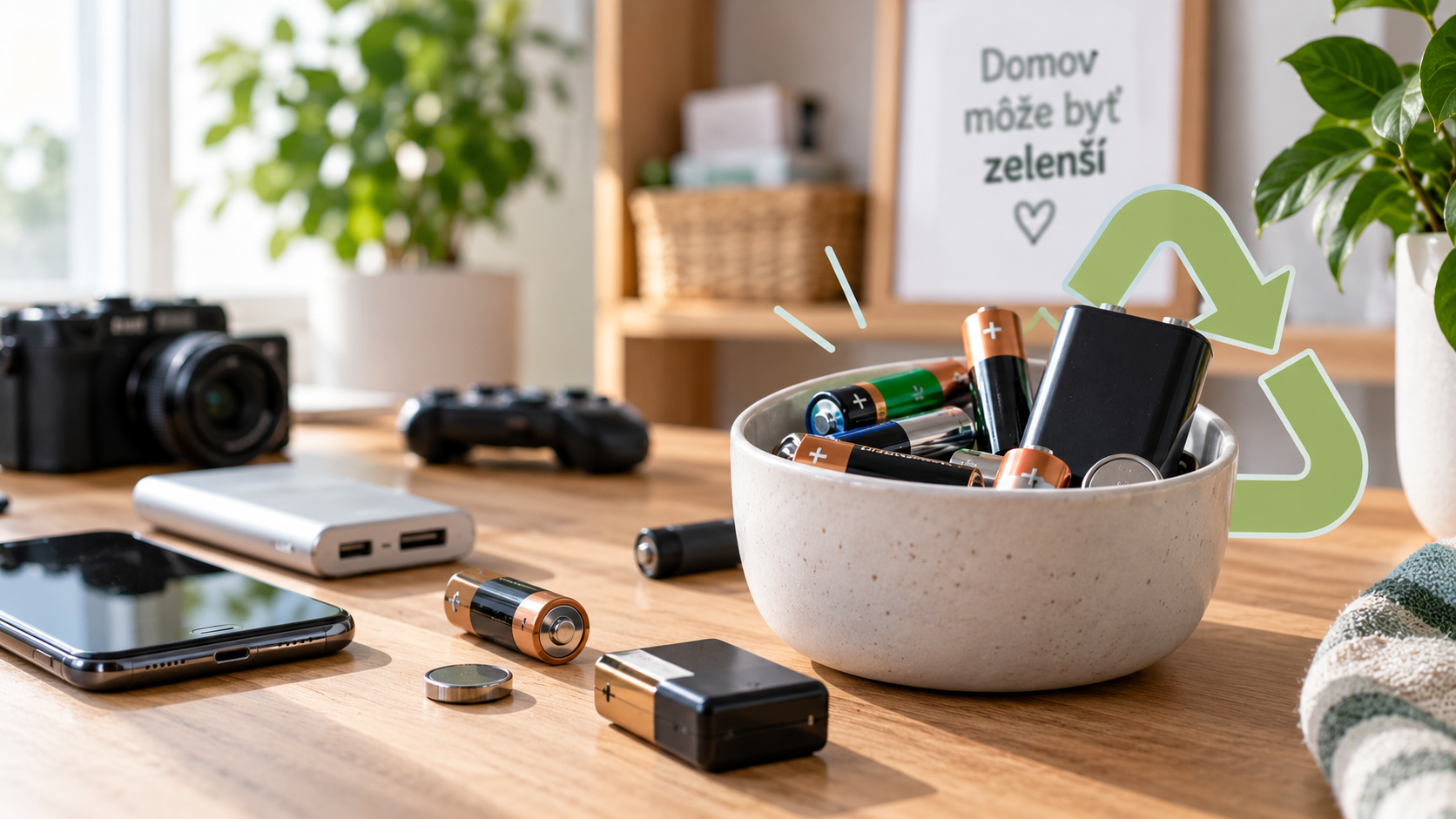
A remote control, a torch, a child’s toy, a wireless mouse, an electric toothbrush, a phone power bank. Batteries and accumulators are found in almost every household. The second week of September in Europe is dedicated to Battery Recycling Week, which is coordinated by EUCOBAT, the European association of collective battery schemes. ASEKOL SK, a producer responsibility organisation, is a member of EUCOBAT and its only member from Slovakia. The timing of Battery Recycling Week is no coincidence: it symbolically marks the birthday of the Italian physicist Luigi Galvani, whose experiments laid the foundations for today’s galvanic cell.
On this occasion, we take a look at what to do with batteries when they reach the end of their life and, conversely, what we should avoid doing.
Why Batteries Do Not Belong in the Bin
A discarded waste battery in mixed waste is not just a wasted resource. Batteries contain metals such as zinc, manganese, nickel, cadmium and lithium, which can be recovered through professional recycling and reused, for example, to make jewellery, spectacle frames or new batteries for electric cars and e-bikes. When a battery ends up in a landfill, these substances are not only lost but may also gradually leak into the soil and water, damaging the environment.
There is also another risk that is often forgotten: damaged batteries and accumulators can cause a dangerous fire in a waste collection truck or at a sorting plant. This is why waste batteries have their own separate route within the waste management system.
Where Batteries Really Belong
Disposing of used batteries correctly is simple:
• Collection bins in shops – shops that sell batteries (electronics stores, drugstores, supermarkets) are legally obliged to take back used batteries, regardless of whether you buy anything from them.
• Red-and-white containers for small electrical waste – in many towns and municipalities in Slovakia, you will find special containers which accept used batteries as well as small appliances (kettles, hair dryers, keyboards).
• Recycling centres – these accept batteries and accumulators, including larger ones, for example from power tools.
• Schools and institutions – they often have their own collection boxes as part of educational projects, such as schools taking part in Recyklohry, the largest school environmental project, which is operated by ASEKOL SK.
At home, it is enough to collect waste batteries on an ongoing basis, for example in a closable box or jar (ideally away from heat and sunlight), and take them to the nearest collection point from time to time. ASEKOL SK operates the most extensive collection network in Slovakia, with almost 6,000 collection points. This makes it very easy to hand in your waste batteries. You can find the nearest collection point here.
What Types of Batteries Are There?
Non-rechargeable (single-use) batteries
• alkaline batteries (AA, AAA)
• button cell batteries (in watches, calculators, remote controls)
Rechargeable batteries and accumulators
• nickel-metal hydride (NiMH) and nickel-cadmium (NiCd) batteries – common rechargeable AA batteries and batteries for older power tools
• lithium-ion (Li-ion) accumulators from phones, tablets, laptops, electric toothbrushes and toys
• power banks
• smaller accumulators from power tools, bicycles and garden equipment (larger ones are best handed in directly at a recycling centre or to the seller)
A Swollen Power Bank or Battery – What Now?
This situation is appearing in households more and more often, and many people are unsure how to react. A swollen battery (accumulator) is damaged and poses a real risk of catching fire. So what is the recommended procedure?
1. Do not handle it unnecessarily, and do not try to “repair” it. Do not pierce it, bend it or open its casing.
2. Stop charging and using it – even a short charge can increase the risk.
3. If you cannot hand it in immediately, place it in a non-flammable container (for example, a metal container or sand) away from heat, sunlight and flammable materials.
4. Do not store it at home for long. The sooner you take it to a collection point, the better.
5. Never put it in mixed waste or in an ordinary sorted-waste container. Report its condition directly when handing it in at a collection point or recycling centre, so that the staff know how to handle it safely.
6. If the situation is acute – the battery is getting very hot, smoking or giving off an odour – proceed as you would in the event of a fire risk: move it (if it is safe to do so) onto a non-flammable surface outside your flat or house, ventilate the area and, if necessary, call the fire brigade.
A Few Practical Tips to Finish
• Keep button cell batteries out of the reach of small children. They are dangerous if swallowed.
• Always remove the batteries from old toys and appliances before disposing of the appliance, and hand them in separately.
• When buying new devices, consider rechargeable batteries. In the long run, they generate less waste.
• Involve children in sorting used batteries, too. A box for waste batteries in the hallway is a simple way to make collecting used batteries a habit at home. Try, for example, Ecocheese boxes.
Handling and handing in used batteries correctly takes only a few minutes, yet in that time you protect nature, save natural resources and the environment, and reduce the risk of fires that can occur when a waste battery is handled incorrectly. Battery Recycling Week is merely a reminder of something we should be doing all year round.